
'World Cup'-strong Quads for Knee Health: Gentle Exercises for Pain and Surgery Recovery
Watch an elite World Cup soccer player strike a ball, cut toward open space, or land after a header. The movement looks smooth, but the knees are absorbing enormous force. A large part of that control comes from the quadriceps, the group of muscles on the front of the thigh.
For daily life, the goal is not to train like a professional athlete. The goal is to help the knee feel supported when walking, climbing stairs, standing from a chair, or recovering from an injury or surgery.
Gentle quadriceps strengthening can be one of the most useful tools for knee health. It is especially helpful when pain, swelling, arthritis, tendon irritation, or surgery has caused the thigh muscles to “shut down.” The key is choosing the right exercises, doing them with good form, and respecting symptoms.
This article is for general education only. It is not a diagnosis or a personal rehab plan. Anyone with new, severe, or worsening knee symptoms should speak with a qualified medical professional.

Why the quadriceps matter so much for knee health
The quadriceps are made of four ("quad") muscles on the front of the thigh. They work together to straighten the knee and control bending. They also help manage force when the foot hits the ground.
The four main parts are:
Rectus femoris
Vastus lateralis
Vastus intermedius
Vastus medialis
The vastus medialis, often discussed as the VMO or vastus medialis obliquus, sits near the inner side of the knee. It gets attention because of its relationship to kneecap control. When the quadriceps contract well, they help guide the patella, or kneecap, as the knee bends and straightens.
That does not mean the VMO works alone. In real movement, the knee relies on the full quadriceps group, hip muscles, foot position, balance, and timing. Still, many people with knee pain notice weakness or poor activation around the inner thigh near the kneecap. That is why gentle VMO-focused exercises often appear in rehab programs.
The knee, quadriceps connection is simple in principle: stronger, better-coordinated thigh muscles can reduce unnecessary strain on irritated joint surfaces, tendons, and ligaments.
The World Cup analogy that makes knee strength easier to understand
A World Cup soccer player does not rely on knee ligaments alone to stop, turn, sprint, or shoot. The player’s quadriceps act like a dynamic braking system.
When the athlete slows down before a cut, the quads help control knee bend. When the athlete lands, the quads help absorb force. When the athlete kicks, the quads help extend the knee with speed and precision.
The VMO plays a quieter role. It is not the headline goal scorer. It is more like a disciplined midfielder who keeps the shape of the team. It helps support the inside portion of the knee and contributes to smoother patellar tracking during controlled movement.
For people dealing with knee pain, the lesson is not to chase explosive drills. The lesson is that knees like controlled strength. A soccer player builds toward rapid movement only after gaining strength, balance, and tolerance. The same principle applies to rehab.
Start with low-load exercises. Build range of motion. Add resistance gradually. Let the knee prove it is ready before asking it to do more.

Why the quad muscle often weakens when the knee hurts
Knee pain can change muscle function quickly. Swelling, irritation, fear of movement, and reduced activity can all make the quadriceps less responsive. This is sometimes called quad inhibition. The muscle is present, but the nervous system does not recruit it normally.
This can happen with:
Patellofemoral pain
Knee arthritis
Meniscus irritation
Ligament injuries
Tendon pain
Postoperative swelling
A period of limping or reduced walking
A person may notice that the thigh looks smaller, the knee feels unstable, or stairs feel harder than flat ground. Standing from a chair may require extra effort from the arms. The knee may feel like it does not fully trust itself.
This is where gentle strengthening can help. The early goal is not maximum strength. It is to restore a clean signal between the brain and the thigh muscle.
A physical therapy plan after knee surgery or an orthopedic injury often starts with simple quad activation, then progresses toward standing strengthening, balance, and walking mechanics as knee pain allows.
Gentle VMO and quadriceps exercises to start with
These exercises are common in early knee rehab because they can be controlled. They should not cause sharp pain, locking, buckling, or increased swelling. Mild muscle effort is expected. Joint pain that lingers or worsens is a sign to scale back and seek guidance.
Quad sets build the foundation
A quad set teaches the thigh to tighten without moving the knee much.
How to do it:
Sit or lie with the leg straight.
Place a small towel under the knee if that feels better.
Tighten the front thigh muscle.
Think about gently pressing the back of the knee toward the floor or towel.
Hold for 3 to 5 seconds.
Relax fully.
Start with 10 repetitions. The kneecap may move slightly upward as the quad tightens. That is a normal sign of activation.
Helpful cue: Try to make the inner thigh near the knee firm without gripping the hip or holding the breath.
Short arc quads train control near extension
This exercise strengthens the quadriceps through a small, comfortable range.
How to do it:
Lie on the back or sit with a rolled towel under the knee.
Let the knee rest in a slightly bent position.
Straighten the knee by lifting the heel.
Pause briefly at the top.
Lower slowly.
This can be useful when full squats or step exercises are too demanding.
Straight leg raises add a little more challenge
A straight leg raise requires the quadriceps to keep the knee straight while the hip lifts the leg.
How to do it:
Lie on the back.
Bend the nonworking knee with that foot on the floor.
Tighten the thigh of the working leg.
Lift the straight leg to the height of the opposite knee.
Lower slowly.
If the knee bends during the lift, return to quad sets first. Keeping the knee straight matters more than lifting high.
Terminal knee extensions help with the last part of knee straightening
Terminal knee extensions are often used to improve control near full extension.
How to do it:
Anchor a light resistance band behind the knee.
Stand with the band pulling the knee slightly forward.
Start with the knee slightly bent.
Tighten the quadriceps and gently straighten the knee.
Pause, then return slowly.
This exercise should feel controlled, not forceful. Use a light band at first.
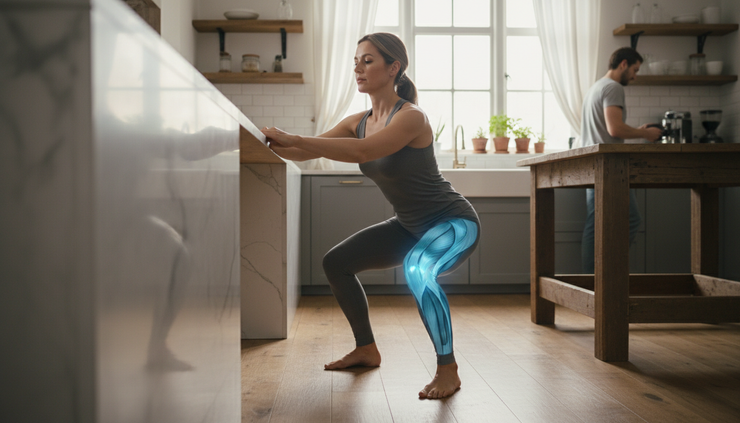
Mini squats build real-life strength
Mini squats connect quad strength to daily movement.
How to do it:
Stand with feet about hip-width apart.
Hold a countertop or stable surface if needed.
Bend the knees slightly, as if starting to sit.
Keep the knees tracking over the middle toes.
Return to standing by pressing through the feet.
Keep the range small at first. A shallow, pain-free squat is more useful than a deep squat with poor control.
How to exercise when knee pain is present
Pain does not always mean an exercise is harmful, but it is useful information. A simple guide is to keep discomfort mild, controlled, and short-lived.
A gentle strengthening session should usually meet these standards:
Pain stays in a mild range during the exercise.
Symptoms do not increase as the set continues.
Swelling does not increase later that day or the next morning.
Walking does not become more difficult after exercise.
The knee does not buckle, lock, or catch sharply.
If symptoms flare, reduce one variable at a time. Use fewer repetitions, less resistance, a smaller range of motion, or more rest between sets.
For example, a mini squat can become a smaller knee bend. A straight leg raise can become a quad set. A band exercise can be done without the band.
The best exercise is not always the hardest one. It is the one that the knee can repeat consistently.
Quad strengthening before knee surgery can improve readiness
Preoperative strengthening is often called “prehab.” The goal is to enter surgery with the best motion, strength, and function that the condition allows.
Before surgery, gentle quad work may help:
Maintain thigh muscle awareness
Reduce deconditioning
Support walking mechanics
Practice exercises that may be used after surgery
Build confidence with safe movement
Prehab should match the diagnosis. A person preparing for an ACL reconstruction, knee replacement, meniscus procedure, or patellar surgery may have different restrictions. Some knees tolerate stationary biking and mini squats. Others need a calmer plan focused on motion, swelling control, and quad sets.
A surgeon or physical therapist should give specific guidance before any planned procedure. This is especially true if the knee has mechanical locking, major instability, or weight-bearing limits.
Quad strengthening after knee surgery should follow the timeline
After surgery, the quadriceps often need retraining. Swelling and pain can make it difficult to tighten the muscle, even when the person is trying hard. Early exercises may seem basic, but they are not trivial.
Common early goals include:
Regaining knee extension
Reducing swelling
Restoring quad activation
Walking with good control
Following weight-bearing rules
Protecting repaired tissue
The safest path depends on the procedure. A total knee replacement plan differs from an ACL reconstruction plan. A meniscus repair often has different limits than a meniscectomy. Cartilage procedures may require longer protection.
That is why post-surgical exercises should follow the surgeon’s protocol and the treating therapist’s plan.
In many cases, early quad sets, ankle pumps, heel slides, and straight leg raises appear before heavier strengthening. Later, the plan may progress to step-ups, sit-to-stands, leg press, balance work, and sport-specific drills.
The World Cup analogy still applies. The athlete earns speed through control. A recovering knee earns harder exercise through calm swelling, good motion, and reliable muscle activation.

Common mistakes that slow quad recovery
Gentle quad strengthening works best when the basics stay clean. These mistakes can make symptoms linger.
Doing too much too soon
A painful knee may tolerate one good set, then object to three more. Progress should come from repeated success, not from forcing the joint to accept more load.
Ignoring swelling
Swelling can inhibit the quadriceps. If the knee becomes puffy after exercise, the program may be too aggressive. Elevation, appropriate icing if advised, compression, and activity changes may help, but medical guidance matters after injury or surgery.
Letting the knee collapse inward
During mini squats, sit-to-stands, and step-ups, the knee should generally track over the foot. A knee that repeatedly drops inward may need hip strengthening, balance work, or a smaller range.
Chasing VMO isolation too aggressively
The VMO is important, but it does not work in total isolation during normal movement. A good plan trains the full quadriceps, hips, calves, and balance system. VMO-focused cues can help, but they should not replace whole-leg control.
Holding the breath
Breath holding can increase tension and make movement feel harder. Exhale during effort. Keep the jaw, shoulders, and hands relaxed.
A simple weekly approach for gentle quad strengthening
A calm starting routine might include 10 to 15 minutes of work, several days per week, if symptoms allow.
A sample session could look like this:
Exercise | Starting amount | Main goal |
Quad sets | 1 to 2 sets of 10 | Wake up the quadriceps |
Short arc quads | 1 to 2 sets of 10 | Control knee straightening |
Straight leg raises | 1 set of 8 to 10 | Hold the knee straight under light load |
Terminal knee extensions | 1 set of 10 | Improve control near full extension |
Mini squats | 1 set of 8 to 10 | Connect strength to daily movement |
This is only an example. Some knees need less. Others can progress to more resistance, deeper ranges, or step exercises. A good rule is to change one thing at a time.
Progress may include:
Adding a few repetitions
Adding a second set
Increasing the hold time
Using a slightly stronger band
Moving from supported to unsupported standing
Adding step-ups when stairs feel controlled
The knee should feel steadier over time, not more irritated.
When to stop and get medical guidance
Some symptoms need professional attention. Stop the exercise and seek care if there is:
Sudden sharp pain
New or worsening swelling
Knee locking
Repeated buckling
Calf swelling or unexplained calf pain
Redness, warmth, or fever after surgery
Inability to bear weight
Pain that does not settle with rest
After any surgery, follow the specific instructions from the surgical team. Restrictions exist to protect healing tissue.
The practical takeaway
World Cup players show what powerful quadriceps can do at the highest level: absorb force, guide the knee, and create controlled movement. For knee pain or surgery recovery, the same principle applies at a gentler scale.
Strong knees are built through patient, repeatable work. Start with quad activation. Respect pain and swelling. Train the VMO as part of the full quadriceps system. Progress from simple floor exercises to standing movements only when the knee is ready.
The goal is not to rush back to elite performance. The goal is a knee that feels more supported with each step, each stair, and each return to daily activity. The Knee Experts at Kamath Orthopedics, including orthopedic surgeon Dr. Atul Kamath, can guide you back to knee health.


Comments